


Handleless Kitchen Cabinets and the Gola Profile: Why the Grip Is a Carcass Decision
By David Rousso Jr., Principal, Pedini by Daruso. Last updated September 2026.
The short answer: A handleless kitchen cabinet is one where the grip has moved off the face of the door and into the cabinet itself. Four systems do that. The gola rail is an aluminum channel fixed to the carcass. The J-pull is a groove milled into the door. Push-to-open is a spring and a catch, with no grip at all. The back bevel is an angled edge you hook with your fingertips. In a photograph they look interchangeable. In use they behave differently, they draw different lines across an elevation, and one of the four changes how every cabinet box in the run is built.
In this article

Search the phrase and almost every page treats handleless as a look: minimal, seamless, European, a matter of taste. It is a look, but the look is the last thing decided. What comes first is where the grip lives, because that decides what the door can be made of, what height the drawers can be, where the shadow line falls, and whether the run reads as one composition or a row of boxes. That is why, in a Pedini by Daruso kitchen, the handleless system is decided with the carcass rather than added to it.
What does handleless actually mean?
A handleless cabinet has no hardware standing forward of the door face. The hand still needs somewhere to go, so the grip is relocated: into a channel on the cabinet, a groove in the door edge, an angled edge, or a mechanism that opens the door when it is pushed. Each relocation is a different piece of engineering, and each one is visible if you know where to look.
Gola (Italian, pronounced GO-la), noun: throat. In cabinetry, an extruded aluminum channel fixed to the cabinet carcass that forms a recess for the hand, allowing doors and drawers to open without handles.
The gola rail
The gola rail is the Italian answer, and the word is Italian. It is an extruded aluminum channel screwed to the carcass, running horizontally along the top of the base units, under the wall units, and vertically between tall doors. The Italian component maker Scilm, founded in 1977 and based at Cittadella near Padua, launched its gola profile system in 1988, and it has been the standard grammar of Italian handleless kitchens since.
The J-pull
The J-pull is a groove cut into the door itself, usually along the top edge of a base door or drawer front and along the side of a tall door. Seen in section it looks like a J. It needs no hardware and no change to the cabinet, which is its whole appeal and its whole limit.
Push-to-open
Push-to-open removes the grip entirely. A spring-loaded ejector in the cabinet, held by a catch or magnet on the door, releases when the door is pressed and pushes it open far enough to grasp its edge. The system most people have met is made by Blum, and versions exist for doors, drawers, and lift-up fronts.
The back bevel
The back bevel is an edge milled at roughly 30 to 45 degrees along the top of a door or drawer front, sloping back toward the cabinet so the fingertips can hook it. Like the J-pull it lives in the door, and unlike the J-pull it leaves no groove, only a shadow.

What are the four handleless systems, and how do they differ?
The differences that matter are not aesthetic. They are where the grip lives, what the door has to be, and what the cabinet has to give up.
Table: the four handleless cabinet systems compared by grip location, opening action, and what each demands of the cabinet and the door.
System | Where the grip lives | How it opens | What it asks of the cabinet | What it asks of the door |
|---|---|---|---|---|
Gola rail | In an aluminum channel fixed to the carcass: horizontal above base units and below wall units, vertical between tall doors | Fingers slide into the channel and pull | The carcass is built around the channel. The profile takes a fixed height from the top of every base unit and a fixed width between tall doors. | Any material within the hinge limit. The door is a plain slab. |
J-pull | In a groove milled into the edge of the door | Fingers hook the groove and pull | Nothing structural. Standard carcass, standard hinges. | A core thick and stable enough to hold a machined edge, with the groove finished as part of the door. |
Push-to-open | Nowhere. A spring ejector in the cabinet and a catch on the door. | Press the door face, the ejector pushes it open, grasp the edge | A mechanism for every door and drawer, a slightly larger front gap, and hardware built to combine ejection with soft close. | Any slab. The door face becomes the touch surface. |
Back bevel | In an angled top edge of the door | Fingertips hook the bevel and pull | Nothing structural. The worktop overhang has to leave finger room. | A door thick enough to carry the bevel and a finish that survives daily contact on the edge. |
Notice which column changes the cabinet. A J-pull and a back bevel are door details, and either can be specified on a standard carcass with nothing else in the run moving. Push-to-open changes the hardware schedule and the gaps. Only the gola rail changes the box, and it changes every box in the run at once.

What does each system do to the reveal?
This is the part competing pages leave out, and it is the reason the systems are not interchangeable.
The reveal is the gap between one door and the next. In a factory built run it is a fixed dimension, held across the whole elevation by CNC machined carcasses and doors. Handleless cabinetry adds a second line to that grid, the line where the hand goes, and each system draws it differently.
A gola rail draws one line. Because the channel belongs to the carcass rather than the door, it is cut to the length of the run, not the width of a door. A drawer stack, a sink base, a dishwasher panel, and a corner unit all sit under the same continuous shadow at the same height. The vertical reveals between doors still exist, but the eye reads the horizontal first, and the run becomes a single elevation.
A J-pull restarts the line at every module. Each groove begins and ends with its own door, so a run of five doors reads as five dashes with a gap at each reveal. On a run of equal widths that rhythm is fine. On a run of mixed widths it becomes a stutter, because the dashes are all different lengths.
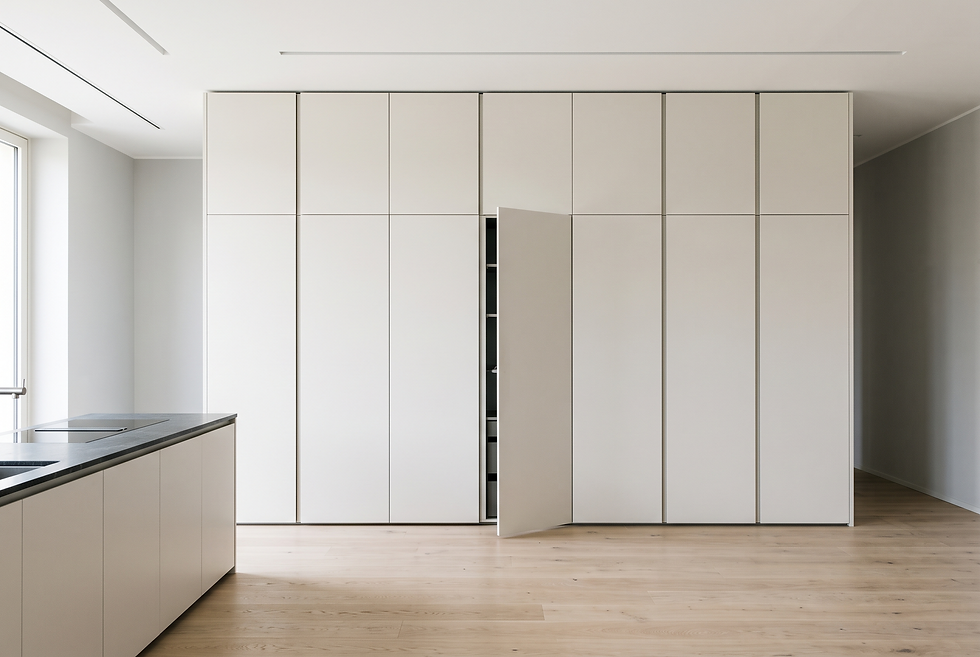
Push-to-open draws no line at all. The elevation is a plain grid of reveals with nothing else on it. On a tall wall of pantry doors that can be exactly what is wanted. On a base run under a worktop it means the eye has nothing to hold, and every small variation in the reveals becomes the only detail there is.
A back bevel draws a shadow rather than a line. It is soft and nearly continuous along the top of a base run, interrupted only slightly at each reveal because the bevel is part of each door. It is the quietest of the four, and it is the one that shows most when the doors are not perfectly coplanar, because the shadow changes with the angle of the light.
So the choice is not really between four handles. It is between one line, many short lines, no line, and a shadow. That is a drawing decision, and it is made before any door is cut.
Clients choose a handleless kitchen from a photograph, which means they are choosing a line without knowing it. Half of what we do in the first meeting is get that line onto the drawing where they can see it, because after the carcass is cut it is no longer a preference. It is a rebuild.
David Rousso Jr., Principal, Pedini by Daruso
What are the drawbacks of each handleless system?
Every one of the four has a place where it stops being the right answer.
Push-to-open in a family kitchen. A door that opens when pressed opens whenever it is pressed: by a hip, a knee, a child, a bag of groceries. Every press is also a fingerprint on the door face rather than in a channel, which on a matte or dark lacquer is visible from across the room. A heavy pot drawer with an ejector does not always sit closed on the first push, and because ejection and soft close pull against each other, the two are only combined in hardware built to do both. It is the right system for a wall of tall doors opened a few times a day. It is rarely the right system for the drawer under the cooktop.
What a gola channel asks of whoever cleans it. The channel is a horizontal shelf at hand height. Crumbs, flour, and the dust of a household land in it, and in a kitchen that is used it is wiped every few days with a damp cloth and mild soap. Abrasive pads and strong alkaline cleaners dull the finish. Under a wall unit the channel collects little and shows less. Above the base units beside the cooktop it collects the most and shows the most, which is an argument for a darker channel there rather than a bright one.
How a groove reads on a tall door. A J-pull on a base door sits under the worktop, where the groove is mostly in shadow. On a tall door the groove has to run vertically along the side, at whatever length the door is, and it sits in full view at eye level. It reads as a stripe. Where a run of tall units meets a run of base units, the vertical grooves and the horizontal grooves arrive at a corner they were never designed to resolve, and that corner is the tell of a J-pull kitchen.
What the bevel does to the finish. The back bevel puts fingers on the door edge every time the door is used, which concentrates wear on the smallest surface of the door. On a high-pressure laminate or a fully cured lacquer that is fine for decades. On a soft finish, or a veneer with a thin face, it is where the door starts to look used first. And because the bevel is an angle rather than a recess, it gives the hand less to hold on a heavy drawer.

Which handleless system should you choose?
Match the system to how the cabinet is used rather than to how the kitchen photographs.
Heavy drawers, daily use, children in the house. A gola rail. It gives the hand a full grip, it cannot open when bumped, and the fingerprints land in a channel rather than on the door face.
A tall wall of doors opened a few times a day. Push-to-open. Nothing interrupts the elevation, and the drawbacks barely apply to a pantry.
A standard carcass you cannot change, or a budget that will not carry profiles. A J-pull, keeping the runs to equal door widths so the grooves read as rhythm rather than stutter.
A run where the quietest possible line is wanted and the doors are a hard finish. A back bevel.
Most real kitchens. Two systems, not one. A gola line below the worktop and push-to-open on the tall run is the most common combination we build, because it puts each system where its weaknesses do not matter.
Why is handleless a carcass decision?
Because the gola channel is part of the box, and the box sets the grid.
Take a base run. Under the worktop sits a C profile, a continuous channel a little over an inch tall that gives the hand its recess. That height comes out of the top drawer front, which is cut shorter to meet the channel. The channel sits at a fixed height on every base unit in the run, so every top drawer front in the run is the same reduced height, and the horizontal line of the elevation is fixed at that dimension from one wall to the other. Change where the channel sits and every drawer front in the kitchen changes with it.
Now add tall units. Between two tall doors sits a vertical profile, which takes a fixed width. Two tall doors and a channel do not add up to the same width as two tall doors and a reveal, so the door widths of a gola pantry are different from the door widths of a J-pull pantry, which means the carcass widths are different, which means the whole tall run lands in a different place on the plan. Where the vertical channel meets the horizontal channel at the top of the base run, the two profiles have to be mitered or capped, and that junction is drawn, not improvised.
This is what it means to say the grip is a carcass decision. A J-pull and a back bevel can be changed at the door stage. Push-to-open can be changed at the hardware stage. A gola rail cannot be changed at any stage after the carcass is drawn, because the carcass was drawn around it. In a Pedini kitchen the channel position, the drawer heights, the tall door widths, and the reveal are one set of numbers, fixed together in the shop drawings and manufactured together in Italy.

Where does handleless meet appliance integration?
The line has to cross the appliances too, and this is where the systems separate again.
A gola run carries its channel over the dishwasher. The dishwasher panel is cut to the same reduced height as the drawer fronts beside it, and the profile runs straight across. A fully integrated refrigerator column takes the vertical profile like any other tall door, with the appliance hinge doing the work behind it. The panel ready appliance joins the grid on the same terms as everything else, which is the argument we made in what a panel ready appliance actually is: the appliance disappears only if the millwork was engineered for it.
A J-pull run has to mill the groove into the appliance panel, so the panel has to be thick enough for the milling and still within the appliance manufacturer's weight limit. Push-to-open on an integrated refrigerator or dishwasher is possible only where the appliance manufacturer offers hardware for it, and not every model does. A back bevel on a dishwasher panel works, provided the worktop overhang leaves finger room above a panel that is often thicker than the drawer fronts beside it.
Whichever system is chosen, the appliance panels are specified with the cabinetry, so that the grip line, the reveal, and the appliance rough-in are resolved together. Settle the appliances and the handleless system separately and one of them will not fit.
What does a gola channel have to survive in South Florida?
Aluminum protects itself with a thin oxide layer, and that layer is enough almost everywhere. It is not enough within reach of salt. Chloride carried in sea air attacks the oxide and pits the metal beneath it, and the architectural finisher Linetec notes that significant airborne chloride deposition has been found more than 50 miles from the coastal shore. A Miami kitchen is an interior room, but many of them sit behind sliding doors that stand open to a terrace half the year, and a gola channel is a horizontal recess at hand height that catches whatever the air carries in.
The answer is the channel finish. Architectural anodizing is graded under the AAMA 611 specification. Class II, at a minimum of 0.4 mil or 10 microns, is tested to 1,000 hours of salt spray; Class I, at 0.7 mil or 18 microns and above, is tested to 3,000 hours and is the grade specified for coastal exposure. A powder coated or lacquered channel, matched to the door color, is the other route, and it also removes the bright aluminum line that some clients would rather not see. Either way, the channel finish belongs on the drawings next to the door finish, not left to whatever the profile ships in.
Maintenance is simple and specific. Rinse with clean water, wipe with mild soap, use no abrasive pads and no strong alkaline or acid cleaners, and keep stainless steel accessories from resting in the channel where moisture can collect between the two metals. The same logic governs the panels themselves, which is a subject we took up separately in which cabinet materials survive Florida humidity.

How we draw a handleless run
The sequence is the same as for any Pedini by Daruso kitchen, and the order is the point.
It begins in the showroom with a floor plan and a conversation about how the kitchen will be used, which is where the handleless system is chosen. How many drawers, how heavy, who opens them, whether there are children in the house, whether the tall run is a pantry that opens twice a day or a working wall. Most of our kitchen collections are drawn handleless, Quadra and Arke among them, and the same collection can carry a gola line in one kitchen and a plain push-to-open elevation in the next.
The shop drawings then fix the numbers together: channel position, drawer heights, tall door widths, profile junctions, the reveal, the appliance rough-ins, and the channel finish for the exposure of the room. Once the drawings are signed, the order goes to the Pedini factory in Italy, where the carcasses, doors, panels, and profiles are machined together so that the line arrives already resolved. We set out the full sequence and its realistic timeline separately.
Installation is supervised by our own Pedini by Daruso personnel and has never been subcontracted in more than twenty-five years of building kitchens in South Florida. On a handleless run that matters more than usual, because a profile a few millimeters off at one end is a line visibly off across the whole room. Our installers are working from the drawings that put it there.
Frequently asked questions
What is a gola profile? A gola profile is an extruded aluminum channel fixed to the cabinet carcass that gives the hand a recess to pull from, so the doors and drawers need no handles. A C shaped profile runs horizontally along the top of the base units, an L or J shaped profile runs beneath the wall units and vertically between tall doors, and the channels are cut to the length of the run rather than the width of each door. The system was launched by the Italian component maker Scilm in 1988.
What does gola mean? Gola is Italian for throat. It describes the recessed channel the fingers slide into, and it is pronounced GO-la.
How do handleless kitchen cabinets open? It depends on the system. With a gola rail or a J-pull, the fingers slide into a channel or groove and pull. With a back bevel, the fingertips hook an angled top edge. With push-to-open, the door is pressed and a spring ejector pushes it open far enough to grasp its edge.
Gola or push-to-open: which is better? For base units and drawers, a gola rail. It gives the hand a real grip, it does not open when bumped, and it keeps fingerprints off the door face. For a wall of tall doors opened a few times a day, push-to-open gives the cleanest elevation. Many kitchens use both, with gola below the worktop and push-to-open on the tall run.
Do handleless cabinets get dirty? Each system collects something different. The gola channel gathers crumbs and dust and is wiped every few days with a damp cloth and mild soap. Push-to-open fronts gather fingerprints on the door face itself, which shows most on matte and dark finishes. A J-pull groove traps more than a channel because it is narrower. A back bevel collects little but wears at the edge where the fingers go.
How do you clean a gola profile? Wipe it every few days with a damp cloth and mild soap, then dry it. Do not use abrasive pads, strong alkaline cleaners, or acid cleaners, all of which dull an anodized finish. Do not leave stainless steel accessories sitting in the channel, where moisture can collect between the two metals.
Can I retrofit a gola profile to my existing cabinets? Rarely, and rarely well. The channel takes height from the drawer fronts and width from the tall doors, so the existing fronts would have to be remade and the carcass tops adapted to carry the profile. A J-pull or a back bevel can be added by replacing the doors on a standard carcass. Push-to-open can be retrofitted with the right hinges or runners and a slightly wider front gap. If a gola line is what you want, plan it as part of a cabinetry project rather than a door swap.
Are handleless cabinets harder to repair? Not harder, but different. A push-to-open ejector is a small mechanical unit that is replaced without touching the door. A damaged gola profile is replaced as a length, matched to the finish of the rest of the run. A damaged J-pull or back bevel is a damaged door, which is remade. In every case the repair is easier when the cabinetmaker still holds the drawings and the finish references.
Do handleless kitchen cabinets cost more? A J-pull or a back bevel adds machining to the door and nothing to the cabinet, so the difference is modest. Push-to-open adds a mechanism to every door and drawer. A gola rail adds the profiles, their finish, and the engineering of the carcass around them, and it is the one system where the cost sits in the drawing as much as in the hardware. Against a kitchen with quality handles the difference is a small part of the whole. The larger cost is choosing the wrong system and remaking the doors to change it, which is part of the wider question of what determines the cost of a custom kitchen.
Key takeaways
Handleless is four different systems, not one style. Gola rail, J-pull, push-to-open, and back bevel.
Only the gola rail changes the cabinet. It takes height from every top drawer front and width from every tall door, so it has to be drawn before the carcass is cut.
Each system draws a different line across the elevation: one continuous line, a dash per door, no line, or a shadow.
Push-to-open belongs on tall doors rather than heavy drawers. A gola rail belongs on the base run.
In South Florida the channel finish matters. Class I anodizing under AAMA 611 is the coastal grade.
The handleless system and the appliance selections have to be settled together, because both set the same numbers.
Bring us the plan, not the door swatch
The grip is a conversation we would rather have at the drawing stage than after the doors are cut. Both of our showrooms keep full-scale handleless kitchens on the floor, so you can put your hand in a gola channel, press a push-to-open door, and feel the difference the photographs cannot show:
Coral Gables. 250 Altara Avenue, Coral Gables, FL 33146. (786) 772-6770
Miami Design District. 3639 NE 1st Ave, Unit 135, Miami, FL 33137. (305) 853-9598
Bring your floor plan, or bring a photograph of a handleless kitchen you like and the question of which system it is. Book a design consultation or explore our kitchen collections.
About the author David Rousso Jr. is Principal at Pedini by Daruso, which designs, manufactures, and installs Italian cabinetry across South Florida from showrooms in Coral Gables and the Miami Design District. He is the second generation of the family firm his father founded in Miami about twenty-five years ago, and works on projects from the first drawing to the final walkthrough.
Sources referenced in this article
Scilm company history, founded 1977, gola profile system launched 1988: scilm.it
Linetec, "How does salt spray affect finished aluminum," on airborne chloride deposition: linetec.com
Linetec, "Class I or Class II Anodize," on AAMA 611 coating thickness and salt spray testing: linetec.com
Last updated: September 2026


Comments